Want to try and want to know how? How to repair your credit?
When someone applies for a loan, a credit card, life insurance, an apartment, or to even apply for a job, your credit report is checked. Your credit report is a blue print for your financial behavior. It contains a history of how one pays their bills and how responsible that person is when handling finances. Not all persons can check your credit history; only a legitimate business like a bank, a retailer, a landlord, the IRS, the court, licensing agencies, or an employer can do so.
If someone has a lousy credit report, it can keep him/her from getting a job or even a promotion. If you have a bad credit history, clean it up. Prove that you have taken care. People will want to do business with you. Here are few tips to clean up your credit history:
* Understand the Fair Credit Reporting Act: This Act gives you the right to see what is in your credit report and dispute any inaccuracies. If you see inaccuracies, it must be investigated and corrected if they are wrong. One can write a statement up to 100 words to explain your case.
* Reporting to Credit Bureaus: The three credit bureaus hold reports for more than 150 million people and one can contact them individually for their personal credit report. The phone numbers and websites are given below:
Equifax 1-800-685-1111 www.equifax.com
Experian 1-888-397-3742 www.experion.com
TransUnion 1-800-916-8800 www.transunion.com
* Correct Errors: When you get a report and find that there is an error such as an account that’s not yours, a payment that was never received, or a typo. The credit report has a complete set of instructions as to how to report the error. It is between the bureau and the creditor who reported the data to correct the error when it is wrong. You will get a written reply within four weeks.
* Validate Your Case: Validate your case by providing reasons for falling behind on your payments, such as a job loss, serious illness, divorce, death in family, stolen identity, natural disaster, or any other compelling reason that you may have. You can also insert a 100 words statement in the report to substantiate your case. The bureau can help you write this statement. The bankers and creditors will know that you are not a reckless person and that you do care.
* Seek Help: If you owe a huge some of money to different credit cards or loans and if you are unable to manage your finances, contact a debt settlement company such as www.debtfreeafterall.com, who are pioneers in debt settlement, debt reduction, and debt negotiations. They can reduce and settle your debt by 30-80% depending upon the type of card or loan you have.
Article Written by Naz
Saturday, November 1, 2008

Tuesday, October 28, 2008
You want to Solve Your Debt or Not?
So, how to do that and how its works?
Now's the time to devise a spending plan that reduces your debt and sets you up to pay on time, every time. If you're having difficulty making payments, be proactive. Call your creditors and negotiate to keep your accounts current and from being reported as delinquent or "bad debt." You can ask for reduced monthly payments or even change due dates to balance out your monthly bills.
The same strategy can be used for fixed-loan payments. Remember, though, that this is a short-term strategy. You'll pay more interest to extend the repayment schedule, but it allows you to stay current and save your credit rating. Use the extra money to pay off debts one at a time, gradually increasing payments to other debts.
Deal with any collection accounts. Unpaid collections are worse than paid collections. You can negotiate a payoff settlement that reduces your bill, plus demand that all derogatory remarks are removed from your credit report or at least reported as paid in full. Be sure to get all agreements in writing before sending off your payment.
Ps: Sometimes, you will feel hard. But its better you try it than not doing anything right?
Now's the time to devise a spending plan that reduces your debt and sets you up to pay on time, every time. If you're having difficulty making payments, be proactive. Call your creditors and negotiate to keep your accounts current and from being reported as delinquent or "bad debt." You can ask for reduced monthly payments or even change due dates to balance out your monthly bills.
The same strategy can be used for fixed-loan payments. Remember, though, that this is a short-term strategy. You'll pay more interest to extend the repayment schedule, but it allows you to stay current and save your credit rating. Use the extra money to pay off debts one at a time, gradually increasing payments to other debts.
Deal with any collection accounts. Unpaid collections are worse than paid collections. You can negotiate a payoff settlement that reduces your bill, plus demand that all derogatory remarks are removed from your credit report or at least reported as paid in full. Be sure to get all agreements in writing before sending off your payment.
Ps: Sometimes, you will feel hard. But its better you try it than not doing anything right?
Saturday, October 25, 2008
Debt, Credit and Solution
This is 5 Step that can help you improving your Credit Rating.
1. Order your credit reports.
2. Examine your reports carefully.
3. Double-D strategy -- dispute and document.
4. Solve and dissolve debt.
5. Add stability to your credit file.
Ps: Please think without think how you want to waste your money. This is nice solution that might be can help.
1. Order your credit reports.
2. Examine your reports carefully.
3. Double-D strategy -- dispute and document.
4. Solve and dissolve debt.
5. Add stability to your credit file.
Ps: Please think without think how you want to waste your money. This is nice solution that might be can help.
Monday, October 20, 2008
2 Reason That Cause You to be a Debt Disaster
First : Failing to alert creditors about a financial hardship
You heard the rumor: Layoffs are coming to a department near you next week.
Don't wait until it happens to worry about how to pay your bills. Do some damage control right away.
Try this: "The best time to negotiate is before the problem spirals downhill," says Cunningham. Call the credit card company and explain the problem you're about to have. Ask if they could temporarily lower your interest rate or extend your payment deadline. Some issuers have in-house help programs that provide such short-term services to customers.
2nd : Thinking of 'budget' as a dirty word
The word may call to mind tedious self-trickery meant for those with low incomes, but everyone can benefit from deciding on certain amounts for spending -- and sticking to the amount. It also makes sense to budget for known future expenses, such as quarterly insurance premiums, college textbooks and rent. Not saving up in advance means you'll have to charge expenses or cut into funds set aside for necessities. Budget these fixed costs while you can handle small financial pinches.

You heard the rumor: Layoffs are coming to a department near you next week.
Don't wait until it happens to worry about how to pay your bills. Do some damage control right away.
Try this: "The best time to negotiate is before the problem spirals downhill," says Cunningham. Call the credit card company and explain the problem you're about to have. Ask if they could temporarily lower your interest rate or extend your payment deadline. Some issuers have in-house help programs that provide such short-term services to customers.
2nd : Thinking of 'budget' as a dirty word
The word may call to mind tedious self-trickery meant for those with low incomes, but everyone can benefit from deciding on certain amounts for spending -- and sticking to the amount. It also makes sense to budget for known future expenses, such as quarterly insurance premiums, college textbooks and rent. Not saving up in advance means you'll have to charge expenses or cut into funds set aside for necessities. Budget these fixed costs while you can handle small financial pinches.
| Debt Plans Break free from the cycle of debtwith the help of the debt specialists! www.trapped.co.uk |
Friday, October 17, 2008
Use Home Equity Loan Method
This is one worse way you can make and try if you want..
Use a home equity loan to pay off credit-card debt
Lenders love to tout home equity loans and lines of credit as a way to pay off your plastic. You'll even see some personal finance journalists parroting the company line that such loans make sense, because home equity rates are typically lower than the interest rates you'd pay on your cards -- and the interest is usually tax deductible.
Americans have been taking this advice with a vengeance, cashing out more than $2 trillion of the equity in their homes between 2002 and 2005, according to SMR Research and Freddie Mac. Comparatively low home-equity rates, and stubbornly high credit-card rates, have convinced millions that this is the way to go.
The only way this maneuver really helps you, however, is if you stop using your credit cards to run up debt. Otherwise, you're just digging yourself a deeper hole.
Unfortunately, the ability to live within their means is beyond many people. Nearly two-thirds of the people who borrowed against their home equity to pay off credit cards had run up more card debt within two years, according to a study by Atlanta research firm Brittain Associates.
Oh, sure, you can borrow more against your home to pay off the new debt -- thus whittling away the amount of equity that's available to you in an emergency, and ensuring that you continue to pay hundreds or thousands of dollars a year in interest to your lender. The credit-card balances you should be paying off every month instead get stretched out for years, ultimately costing you more in interest -- even with the tax savings.
Ps: Its risky. But its up to you want to try or not.
Use a home equity loan to pay off credit-card debt
Lenders love to tout home equity loans and lines of credit as a way to pay off your plastic. You'll even see some personal finance journalists parroting the company line that such loans make sense, because home equity rates are typically lower than the interest rates you'd pay on your cards -- and the interest is usually tax deductible.
Americans have been taking this advice with a vengeance, cashing out more than $2 trillion of the equity in their homes between 2002 and 2005, according to SMR Research and Freddie Mac. Comparatively low home-equity rates, and stubbornly high credit-card rates, have convinced millions that this is the way to go.
The only way this maneuver really helps you, however, is if you stop using your credit cards to run up debt. Otherwise, you're just digging yourself a deeper hole.
Unfortunately, the ability to live within their means is beyond many people. Nearly two-thirds of the people who borrowed against their home equity to pay off credit cards had run up more card debt within two years, according to a study by Atlanta research firm Brittain Associates.
Oh, sure, you can borrow more against your home to pay off the new debt -- thus whittling away the amount of equity that's available to you in an emergency, and ensuring that you continue to pay hundreds or thousands of dollars a year in interest to your lender. The credit-card balances you should be paying off every month instead get stretched out for years, ultimately costing you more in interest -- even with the tax savings.
Ps: Its risky. But its up to you want to try or not.
Saturday, October 11, 2008
Advantages and Disadvantages of Debt Consolidation
What do you know about Advantages and Disadvantages of Debt Consoludion?
Debt Consolidation:
Consolidating your existing debts is another viable option to get out of debt. Prior to taking the debt consolidation route take a look at its pros and cons.
Advantages:
* You have to make just one payment at the end of each month. It has been noticed that the average citizen pays 12 different creditors every month. Therefore, it becomes very difficult for the individuals to figure out whom to pay. With the help of debt consolidation all your debts are being combined, this makes managing your finances much easier.
* Debt consolidation can significantly reduce high interest rates.
* With reduced interest rate and one monthly payment, the amount you have to shell out each month is decreased significantly.
* If you are planning to use a first or second mortgage as a debt consolidation loan then the interest is tax-deductible.
Disadvantages:
* Reduced monthly payment indicates easier load to bear and more money left over at the end of the month. This might tempt you to take on more debt.
* Even though the interest rate is reduced, the repayment period is extended. Thus, you may end up spending more money than what you would have if you had kept each individual loan.
* You can lose everything. If you take out a secured consolidation loan against your home and you miss two to three payments, in that case you might even lose your home.
Ps: I believe, my husband now about this one.
Debt Consolidation:
Consolidating your existing debts is another viable option to get out of debt. Prior to taking the debt consolidation route take a look at its pros and cons.
Advantages:
* You have to make just one payment at the end of each month. It has been noticed that the average citizen pays 12 different creditors every month. Therefore, it becomes very difficult for the individuals to figure out whom to pay. With the help of debt consolidation all your debts are being combined, this makes managing your finances much easier.
* Debt consolidation can significantly reduce high interest rates.
* With reduced interest rate and one monthly payment, the amount you have to shell out each month is decreased significantly.
* If you are planning to use a first or second mortgage as a debt consolidation loan then the interest is tax-deductible.
Disadvantages:
* Reduced monthly payment indicates easier load to bear and more money left over at the end of the month. This might tempt you to take on more debt.
* Even though the interest rate is reduced, the repayment period is extended. Thus, you may end up spending more money than what you would have if you had kept each individual loan.
* You can lose everything. If you take out a secured consolidation loan against your home and you miss two to three payments, in that case you might even lose your home.
Ps: I believe, my husband now about this one.
Thursday, October 9, 2008
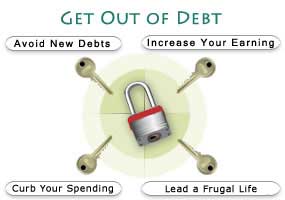
How To Get Out from Having Debt?
Did you know how my Husband manage to get out of debt until today? Looks this. Even its not all his method. But this some method really works to him.
1. Avoid new debts
When you are already in debt, do not involve into more debts. This will increase your debt burden and lead you to more trouble. While you are already missing your regular payments yet taking newer debts, debt handling becomes a difficult task. Sometimes the situation can even go beyond control. It might be so critical that you end up declaring yourself as a bankrupt.
2. Spend less
Each penny counts; save every dollar. If you are seriously planning to pay off your pending debts, start to become frugal. But, do not change your way of life suddenly, it might create an adverse effect. Read as many frugal tips you can, and try to follow them effectively. Efficient budgeting can save you some bucks to reduce your debts faster.
3. Increase your earning
Earn more. If required, take up part time jobs or try other ways, for extra earning. Add itional inflow of money can help you to clear off your debts quickly, and become financially free.
4. Extend your learning
Finance, is the most important part in your day to day life. Try to know about it as much as you can. Researching on finance, reading good financial books and magazines will make you more experienced and well-versed in managing finances. This will help you to handle your pending debts proficiently.
You just need to get a good understanding of the 3 step formulae, and apply it effectively. This will help you to accumulate sufficient money to clear your pending debts. The process will be effective when you are determined and confident in following the three steps.
Ps: Worth to try. But the result is in your hand.
1. Avoid new debts
When you are already in debt, do not involve into more debts. This will increase your debt burden and lead you to more trouble. While you are already missing your regular payments yet taking newer debts, debt handling becomes a difficult task. Sometimes the situation can even go beyond control. It might be so critical that you end up declaring yourself as a bankrupt.
2. Spend less
Each penny counts; save every dollar. If you are seriously planning to pay off your pending debts, start to become frugal. But, do not change your way of life suddenly, it might create an adverse effect. Read as many frugal tips you can, and try to follow them effectively. Efficient budgeting can save you some bucks to reduce your debts faster.
3. Increase your earning
Earn more. If required, take up part time jobs or try other ways, for extra earning. Add itional inflow of money can help you to clear off your debts quickly, and become financially free.
4. Extend your learning
Finance, is the most important part in your day to day life. Try to know about it as much as you can. Researching on finance, reading good financial books and magazines will make you more experienced and well-versed in managing finances. This will help you to handle your pending debts proficiently.
You just need to get a good understanding of the 3 step formulae, and apply it effectively. This will help you to accumulate sufficient money to clear your pending debts. The process will be effective when you are determined and confident in following the three steps.
Ps: Worth to try. But the result is in your hand.
Monday, October 6, 2008
Tuesday, September 30, 2008
Did your husband cheat behind you?
I'm tired today. My husband going home really late.

I wonder why he really late today. I hope he not have others girl outside. If not, i will kill him. How dare if he did that to me. I'm loyal servant to him even i always ask him for money and shopping. But its enough to cheat me right?
Ps: So, which one of this girls might be will be have scandals with my husbands? I hope not a single of them. Huu..

I wonder why he really late today. I hope he not have others girl outside. If not, i will kill him. How dare if he did that to me. I'm loyal servant to him even i always ask him for money and shopping. But its enough to cheat me right?
Ps: So, which one of this girls might be will be have scandals with my husbands? I hope not a single of them. Huu..
Wednesday, September 24, 2008
How You Choose Contractor?
If you want to find Contractor, what requirement you need to see?
Look for experience. While inexperienced contractors often cost less, it pays to hire a contractor who has swung a hammer more than once and understands the difficulties that can arise on a remodeling project. You’ll want to hire someone who has done a home remodeling project before; otherwise, you may end up spending more to fix mistakes.
While new construction contractors may be skilled, they often aren’t used to working closely with individual homeowners, which can make for some sticky interactions, Deras says. She recommends hiring a local contractor who knows folks at the building department. That contractor will know which permits to get and who to work with, thus speeding the project along.
Ask whether the contractor employs subcontractors. If he does, find out about the subcontractors’ experience, and the contractor’s experience with them. Herriges, for example, has used the same plumber on a variety of projects over the past 32 years.
Get references. This seems like common sense, but when work on your home involves thousands of dollars, you need to do a bit of digging around in a contractor’s background. Find out if he or she is a member of any local or national trade associations and is in good standing with the Better Business Bureau. Ask for references from other jobs he or she has done.
If the job costs more than $30,000, go and see the contractor’s work firsthand, says Herriges. You’ll also want to verify the contractor’s license and insurance. Ask to see the actual documents. If the contractor is not insured, you’re financially liable for any accident that occurs on your property.
You can read full articles in this site : How to choose your Contractor!
PS: Thats why i said to him, choose it wisely, Never choose it because that contractor is your old friends.
Look for experience. While inexperienced contractors often cost less, it pays to hire a contractor who has swung a hammer more than once and understands the difficulties that can arise on a remodeling project. You’ll want to hire someone who has done a home remodeling project before; otherwise, you may end up spending more to fix mistakes.
While new construction contractors may be skilled, they often aren’t used to working closely with individual homeowners, which can make for some sticky interactions, Deras says. She recommends hiring a local contractor who knows folks at the building department. That contractor will know which permits to get and who to work with, thus speeding the project along.
Ask whether the contractor employs subcontractors. If he does, find out about the subcontractors’ experience, and the contractor’s experience with them. Herriges, for example, has used the same plumber on a variety of projects over the past 32 years.
Get references. This seems like common sense, but when work on your home involves thousands of dollars, you need to do a bit of digging around in a contractor’s background. Find out if he or she is a member of any local or national trade associations and is in good standing with the Better Business Bureau. Ask for references from other jobs he or she has done.
If the job costs more than $30,000, go and see the contractor’s work firsthand, says Herriges. You’ll also want to verify the contractor’s license and insurance. Ask to see the actual documents. If the contractor is not insured, you’re financially liable for any accident that occurs on your property.
You can read full articles in this site : How to choose your Contractor!
PS: Thats why i said to him, choose it wisely, Never choose it because that contractor is your old friends.
Monday, September 15, 2008
How to Cut the Cost of Auto Insurance?
Good tips for you todays. Did you want to lower the cost of your auto insurance? It may not be as difficult as you think.
With a phone call or quick trip to the Internet, you could cut your premium and keep a few extra dollars in your pocket. Here’s how:
1. Try bundling. Opting for multiple policies with the same company “is definitely one way to trim costs,” says Doug Borkowski, director of the Iowa State University Financial Counseling Clinic. Look into grouping types of coverage (such as home and auto) or insuring more than one car with the same company.
2. Inform your agent of your good habits. Make sure your agent knows about all the safety features in your car (such as antilock brakes and side-curtain airbags), your teen’s good grades and that you haven’t had an accident since college. All will likely help you keep more of your cash at premium time.
3. Raise your deductible. The classic law of insurance is the lower your deductible, the higher your premium. If you can afford to keep your deductible at $500 or $1,000, you’ll usually see the best rates, says Jack Hungelmann, insurance agent and author of Insurance for Dummies (Wiley). If you go above $1,000, you won’t see much in the way of savings—and you’ll get a huge bill if you have an accident.
And more and more tips. You can know more here if you like : More tips Please!
With a phone call or quick trip to the Internet, you could cut your premium and keep a few extra dollars in your pocket. Here’s how:
1. Try bundling. Opting for multiple policies with the same company “is definitely one way to trim costs,” says Doug Borkowski, director of the Iowa State University Financial Counseling Clinic. Look into grouping types of coverage (such as home and auto) or insuring more than one car with the same company.
2. Inform your agent of your good habits. Make sure your agent knows about all the safety features in your car (such as antilock brakes and side-curtain airbags), your teen’s good grades and that you haven’t had an accident since college. All will likely help you keep more of your cash at premium time.
3. Raise your deductible. The classic law of insurance is the lower your deductible, the higher your premium. If you can afford to keep your deductible at $500 or $1,000, you’ll usually see the best rates, says Jack Hungelmann, insurance agent and author of Insurance for Dummies (Wiley). If you go above $1,000, you won’t see much in the way of savings—and you’ll get a huge bill if you have an accident.
And more and more tips. You can know more here if you like : More tips Please!
Tuesday, September 9, 2008
Why you need to stop Auto Payment?
Stop those automated payments!
There are many reasons you may want to halt an automated payment. If you need to close your account, your credit card number gets changed, or if you’ve changed service providers, you’ll want to take these steps to stop your automated payments:
If you pay through your bank:
Contact the bank by phone at least three days before the payment is made. Follow up with a certified letter within two weeks.
Banks sometimes tell consumers to work it out with the merchant, says Chi Chi Wu, staff attorney for the National Consumer Law Center. Instead, invoke the Electronic Fund Transfer Act, which governs automatic bank drafts and puts the responsibility to stop payments on the bank—not the merchant. You can also copy the merchant on the letter to show the bank that the creditor is aware of your wishes.
If you pay via credit card:
It’s actually up to the merchant to stop the charges, not the card company, says Wu. At the same time, you have more protection from unauthorized drafts and mistakes, and you’re not fighting to recoup money that’s already missing from your account, she says.
Notify the merchant and the credit card company separately that you’re stopping automatic payments. Follow up with certified letters to each, and dispute any subsequent charges.
Please read more here to understand clearly : Auto Payment Issue
—Dana Dratch
Ps: Thats why i hate when he paying like that. Right now, we paying manually. Its more better and i can have walk shopping when he paying bills at bank. Huhu..
There are many reasons you may want to halt an automated payment. If you need to close your account, your credit card number gets changed, or if you’ve changed service providers, you’ll want to take these steps to stop your automated payments:
If you pay through your bank:
Contact the bank by phone at least three days before the payment is made. Follow up with a certified letter within two weeks.
Banks sometimes tell consumers to work it out with the merchant, says Chi Chi Wu, staff attorney for the National Consumer Law Center. Instead, invoke the Electronic Fund Transfer Act, which governs automatic bank drafts and puts the responsibility to stop payments on the bank—not the merchant. You can also copy the merchant on the letter to show the bank that the creditor is aware of your wishes.
If you pay via credit card:
It’s actually up to the merchant to stop the charges, not the card company, says Wu. At the same time, you have more protection from unauthorized drafts and mistakes, and you’re not fighting to recoup money that’s already missing from your account, she says.
Notify the merchant and the credit card company separately that you’re stopping automatic payments. Follow up with certified letters to each, and dispute any subsequent charges.
Please read more here to understand clearly : Auto Payment Issue
—Dana Dratch
Ps: Thats why i hate when he paying like that. Right now, we paying manually. Its more better and i can have walk shopping when he paying bills at bank. Huhu..
Thursday, September 4, 2008
Did your kids have money allowance?
Want your kids to be smart with money? The first step is the hardest: you’ve got to give them some of the green stuff to manage.
An allowance gives parents the opportunity to teach money skills. And it works because it’s relevant to kids, says Lynne Strang, vice president of communications for the American Financial Services Association Education Foundation. “You’re talking about their own money versus someone else’s money,” she says.
Here are seven steps to giving an allowance:
1. Decide whether the allowance will be conditional.
Some parents tie an allowance to completing specific, regular chores, like making the bed, taking out trash or maintaining a neat room. Others don’t like the idea, fearing that—if the child doesn’t want to work—he or she will just forgo the allowance to opt out of helping around the house.
So should an allowance be tied to performing certain jobs?
“I think we fall somewhere in between,” Strang says of her group. “It’s a good idea that kids are expected to have certain core responsibilities.”
Tying an allowance to completing certain regular household chores “is a really bad idea,” says Joline Godfrey, author of “Raising Financially Fit Kids.” “An allowance is not a salary or entitlement. It’s a tool.”
At the same time, if kids do something extra (cleaning out the garage or washing the car), “it makes sense that the parent would pay for jobs that go above and beyond,” Strang says.
If you do decide to assign chores, you’ll want a simple way to keep track of who is doing what each week, says Strang. If kids need some structure or a visual reminder, keep the chores chart in a prominent place, where you and they see it regularly.
Your ultimate goal? Encourage the child to keep track of it on his or her own, says Godfrey. Because, she says, “unless you find a way to put some responsibility on the kids, it’s exhausting.”
2. Set an amount.
“This is a personal decision” that varies from family to family, Strang says.
Some factors to consider: How old is the child? What obligations do you want the child to manage (e.g., school lunches, activity fees)? Realistically speaking, how much money does the child need for those items? And how much discretionary money do you want left?
3. Establish a regular pay day.
How often do you want to pay an allowance? For smaller kids, paying a weekly allowance usually works fine. For high schoolers, consider a monthly plan, says Strang. It more closely mirrors the challenges they’ll face in adulthood, namely budgeting a set amount of money across a month.
It also gives you an excuse to sit down with them and analyze monthly expenses and income, she says.
4. Start small with young kids.
Don’t be afraid to say “this is your lunch money budget” or “this is your comic book budget,” says Godfrey. “Start with something concrete and real that can be understood,” she says. And when the child masters that, you can add to his or her financial responsibilities.
YOu can contunue read here. Because i feel you can know more about your kids and how to control their allowance.
Ps: I hope, when i have kids, they will never ask about money. All money is mine. Haha!
An allowance gives parents the opportunity to teach money skills. And it works because it’s relevant to kids, says Lynne Strang, vice president of communications for the American Financial Services Association Education Foundation. “You’re talking about their own money versus someone else’s money,” she says.
Here are seven steps to giving an allowance:
1. Decide whether the allowance will be conditional.
Some parents tie an allowance to completing specific, regular chores, like making the bed, taking out trash or maintaining a neat room. Others don’t like the idea, fearing that—if the child doesn’t want to work—he or she will just forgo the allowance to opt out of helping around the house.
So should an allowance be tied to performing certain jobs?
“I think we fall somewhere in between,” Strang says of her group. “It’s a good idea that kids are expected to have certain core responsibilities.”
Tying an allowance to completing certain regular household chores “is a really bad idea,” says Joline Godfrey, author of “Raising Financially Fit Kids.” “An allowance is not a salary or entitlement. It’s a tool.”
At the same time, if kids do something extra (cleaning out the garage or washing the car), “it makes sense that the parent would pay for jobs that go above and beyond,” Strang says.
If you do decide to assign chores, you’ll want a simple way to keep track of who is doing what each week, says Strang. If kids need some structure or a visual reminder, keep the chores chart in a prominent place, where you and they see it regularly.
Your ultimate goal? Encourage the child to keep track of it on his or her own, says Godfrey. Because, she says, “unless you find a way to put some responsibility on the kids, it’s exhausting.”
2. Set an amount.
“This is a personal decision” that varies from family to family, Strang says.
Some factors to consider: How old is the child? What obligations do you want the child to manage (e.g., school lunches, activity fees)? Realistically speaking, how much money does the child need for those items? And how much discretionary money do you want left?
3. Establish a regular pay day.
How often do you want to pay an allowance? For smaller kids, paying a weekly allowance usually works fine. For high schoolers, consider a monthly plan, says Strang. It more closely mirrors the challenges they’ll face in adulthood, namely budgeting a set amount of money across a month.
It also gives you an excuse to sit down with them and analyze monthly expenses and income, she says.
4. Start small with young kids.
Don’t be afraid to say “this is your lunch money budget” or “this is your comic book budget,” says Godfrey. “Start with something concrete and real that can be understood,” she says. And when the child masters that, you can add to his or her financial responsibilities.
YOu can contunue read here. Because i feel you can know more about your kids and how to control their allowance.
Ps: I hope, when i have kids, they will never ask about money. All money is mine. Haha!
Monday, September 1, 2008
I just want to Loving you more..
You want money? Have big problem with your financial? I advice you to read this article. Even maybe you already rich and have no problem with your life, why not you add more knowledge today?
Getting paid can be a nightmare for any business, but dealing with accounts receivable can be particularly harsh for sole proprietors. Focusing on collections means losing out on billable hours. Soloists can learn a lot, however, from the methods of Rosemary Sadez Friedmann, who owns an interior-design business with $2.5 million in revenues in Naples, Fla. She's been on her own for 19 years, dealing with a high-end crowd that can be particular about what it's paying for.
Friedmann's first principle is to stagger the timing of all her long-term jobs. Ideally, if she's working on three projects simultaneously, at any given moment she'll be starting one, in the middle of a second, and concluding a third. That way, she has to worry about collecting from only one customer at a time. "If a big job has to be done immediately, I usually have to beg off," she says.
Her key to successful staggering is limiting herself to four large-scale projects a year. She's learned from experience that any more of a workload is all-consuming and compromises the time management benefits that the staggering was designed to create. Friedmann maintains her pace by practicing a crucial soloist art: staving off customers without actually saying no to them.
With rare exceptions, Friedmann meets with all prospective customers, as a visible attempt to work their needs into her strategic scheduling. If the scheduling proves impossible, she often compensates by offering to work as an hourly consultant, thus generating good word of mouth without overlooking her major project commitments. The initial interview also allows her to screen customers. If they don't seem like trustworthy payers, she can decline to do the job or offer to do it only if the customer signs a property lien.
Friedmann hasn't lost out on a payment in more than four years. And just as important, she's managed to stay solo for all that time, when many with her income might have splurged on an employee to handle the headaches. "I often think, 'Boy, it would be so much easier if I had someone else who could just make phone calls,' " she says. "But the other side of the coin is, I'm in tune with every side of my clients' accounts. And there's nothing that's going wrong."
Ps: You also can make money from Mutual investment if you want!
Pss: I also hope my men know what he doing now. I'm not angry dear. I'm just want to loving you more..
Getting paid can be a nightmare for any business, but dealing with accounts receivable can be particularly harsh for sole proprietors. Focusing on collections means losing out on billable hours. Soloists can learn a lot, however, from the methods of Rosemary Sadez Friedmann, who owns an interior-design business with $2.5 million in revenues in Naples, Fla. She's been on her own for 19 years, dealing with a high-end crowd that can be particular about what it's paying for.
Friedmann's first principle is to stagger the timing of all her long-term jobs. Ideally, if she's working on three projects simultaneously, at any given moment she'll be starting one, in the middle of a second, and concluding a third. That way, she has to worry about collecting from only one customer at a time. "If a big job has to be done immediately, I usually have to beg off," she says.
Her key to successful staggering is limiting herself to four large-scale projects a year. She's learned from experience that any more of a workload is all-consuming and compromises the time management benefits that the staggering was designed to create. Friedmann maintains her pace by practicing a crucial soloist art: staving off customers without actually saying no to them.
With rare exceptions, Friedmann meets with all prospective customers, as a visible attempt to work their needs into her strategic scheduling. If the scheduling proves impossible, she often compensates by offering to work as an hourly consultant, thus generating good word of mouth without overlooking her major project commitments. The initial interview also allows her to screen customers. If they don't seem like trustworthy payers, she can decline to do the job or offer to do it only if the customer signs a property lien.
Friedmann hasn't lost out on a payment in more than four years. And just as important, she's managed to stay solo for all that time, when many with her income might have splurged on an employee to handle the headaches. "I often think, 'Boy, it would be so much easier if I had someone else who could just make phone calls,' " she says. "But the other side of the coin is, I'm in tune with every side of my clients' accounts. And there's nothing that's going wrong."
Ps: You also can make money from Mutual investment if you want!
Pss: I also hope my men know what he doing now. I'm not angry dear. I'm just want to loving you more..
Thursday, August 28, 2008
Did you ver know about Private Mortgage?
Private mortgage notes, also referred to as owner financed mortgage notes, have become more prevalent because they offer three distinct advantages. Conversely, as the situation changes there are three very powerful reason to sell a note.
There are three primary reason that a private mortgage note is established:
1. The buyer was not able to obtain traditional financing.
A little more than half of all applicants, and the numbers is going up, do not qualify for the full amount of the loan that they seek.
2. The owner wants to save time and money.
Utilizing owner financing the owner and buyer can save on the extraneous fees associated with the closing, such as origination fees, closing cost and survey fees.
3. An investment opportunity for the seller. Depending on the sellers circumstances, it may make sense to self-finance for tax purposes.
After the note has seasoned the seller's motives may have changed, resulting in the desire to sell the note. For whatever reason, the seller may want to sell the note for a lump-sum payment. This is very common and these types of transactions occur daily.
Transaction like these are available for residential notes, business notes and vacant land notes. But not all funding sources support all three. One can visit www.divergentgroup.com to find more information about selling a private mortgage note.
The benefits of selling a private mortgage note are numerous but the top three are:
1. It provides immediate cash;
2. The seller no longer has to collect payments on the note;
3. The seller no longer has the risk of non-payment.
Divergent Capital Group represents over 200 institutional investors that purchase private mortgage notes for immediate cash. This creates competition, allowing the most competitive deals available. Visit http://www.divergentgroup.com for more information.
Greg Meares is the principal of Divergent Capital Group and a certified cash flow consultant. Helping others achieve their goals, get out of an adverse financial situation or just trade in payments for a lump-sum is good business. Divergent Capital Group facilitates (no cost to you) the best deal for your situation. Over 200 funding groups are utilized and they compete for your business. Other helpful information regarding private mortgage notes can be found at: http://www.divergentgroup.com
There are three primary reason that a private mortgage note is established:
1. The buyer was not able to obtain traditional financing.
A little more than half of all applicants, and the numbers is going up, do not qualify for the full amount of the loan that they seek.
2. The owner wants to save time and money.
Utilizing owner financing the owner and buyer can save on the extraneous fees associated with the closing, such as origination fees, closing cost and survey fees.
3. An investment opportunity for the seller. Depending on the sellers circumstances, it may make sense to self-finance for tax purposes.
After the note has seasoned the seller's motives may have changed, resulting in the desire to sell the note. For whatever reason, the seller may want to sell the note for a lump-sum payment. This is very common and these types of transactions occur daily.
Transaction like these are available for residential notes, business notes and vacant land notes. But not all funding sources support all three. One can visit www.divergentgroup.com to find more information about selling a private mortgage note.
The benefits of selling a private mortgage note are numerous but the top three are:
1. It provides immediate cash;
2. The seller no longer has to collect payments on the note;
3. The seller no longer has the risk of non-payment.
Divergent Capital Group represents over 200 institutional investors that purchase private mortgage notes for immediate cash. This creates competition, allowing the most competitive deals available. Visit http://www.divergentgroup.com for more information.
Greg Meares is the principal of Divergent Capital Group and a certified cash flow consultant. Helping others achieve their goals, get out of an adverse financial situation or just trade in payments for a lump-sum is good business. Divergent Capital Group facilitates (no cost to you) the best deal for your situation. Over 200 funding groups are utilized and they compete for your business. Other helpful information regarding private mortgage notes can be found at: http://www.divergentgroup.com
Wednesday, August 27, 2008
Did you survive when economy downturn?
Surviving an Economic Downturn
The unemployment rate is on the rise, the stock market has been giving investors a scary ride, the American homeowners' biggest asset has been devalued, inflation is pushing up the price of everything, and we still have a family to feed...
It's easy to get careless about finances when times are good and credit is easy, but the recent problems in the U.S. have forced many of us to take a harder look at how we're earning and spending our money. There may be a lot of money-related problems in our nation right now, but the individual consumer really has most of the control over what happens with their personal financial situation, no matter what's going on with the economy.
Improve your job security. Some industries, such as manufacturing and construction and certain service-provider positions, have already lost many jobs due to the mortgage mess and the general state of the economy. If you feel your job is at risk, do what you can to be more valuable to your employer so they can't afford to lose you. Job cuts always start with the least productive or least necessary employees, and you'll increase your chance of keeping your job if you can do what others can't or won't do. Even if you don't feel like you may lose your job, it's always a good policy to outshine the other employees at least a little; you may even get a promotion because you stood out from the rest.
Searching for a job? Search harder. It's easy to get stuck in your comfort zone and only apply for jobs that you have the education or experience for. And it's logical to only want a job that will pay you for your education or experience. But if your industry has been hit hard by job loss, you may need to be more flexible in your job search. Looking outside your chosen field and being willing to learn something new will increase your chances of finding work. This may be the perfect time for a career change.
You can see full articles at this site first : Go here!
Ps: I really hope my hubby will not have problem with his business. I know its really hard. But i want he survive. If not, how can i will be with him forever? I don't want to live with one man who lost in his way..
The unemployment rate is on the rise, the stock market has been giving investors a scary ride, the American homeowners' biggest asset has been devalued, inflation is pushing up the price of everything, and we still have a family to feed...
It's easy to get careless about finances when times are good and credit is easy, but the recent problems in the U.S. have forced many of us to take a harder look at how we're earning and spending our money. There may be a lot of money-related problems in our nation right now, but the individual consumer really has most of the control over what happens with their personal financial situation, no matter what's going on with the economy.
Improve your job security. Some industries, such as manufacturing and construction and certain service-provider positions, have already lost many jobs due to the mortgage mess and the general state of the economy. If you feel your job is at risk, do what you can to be more valuable to your employer so they can't afford to lose you. Job cuts always start with the least productive or least necessary employees, and you'll increase your chance of keeping your job if you can do what others can't or won't do. Even if you don't feel like you may lose your job, it's always a good policy to outshine the other employees at least a little; you may even get a promotion because you stood out from the rest.
Searching for a job? Search harder. It's easy to get stuck in your comfort zone and only apply for jobs that you have the education or experience for. And it's logical to only want a job that will pay you for your education or experience. But if your industry has been hit hard by job loss, you may need to be more flexible in your job search. Looking outside your chosen field and being willing to learn something new will increase your chances of finding work. This may be the perfect time for a career change.
You can see full articles at this site first : Go here!
Ps: I really hope my hubby will not have problem with his business. I know its really hard. But i want he survive. If not, how can i will be with him forever? I don't want to live with one man who lost in his way..
Sunday, August 24, 2008
Say No to Tax?
You hate Tax? same with me!
No one likes paying tax. Everyone understands that tax is a necessary evil and that without it our government would not be able to afford our roads, health services, education, welfare system etc. However you are not obliged to pay more tax than that for which you are legally liable.
Here are some tips to keep your tax down:
- Reduce all stock to levels and cut costs.
Never carry excess stock because that is money that is sitting on the shelves and not in your bank. - Clear out stock that is slow.
Clear stocks and turn them into cash. If necessary reduce your prices and turn stock into cash rather than have it sitting on the shelves or in the warehouse. Best to cut your losses and use the cash to buy in stock that does sell. - Reduce rental costs.
Cut your rental cost by letting out or letting go space that are excess to your requirements. Talk to your landlord about what you can do. It may be that you can obtain approval to rent out areas that you don't need. - Pay your bills on time but not before the due date.
Do not pay your bills too early because having the money sitting in your bank will reduce your bank fees and interest costs. Make use of any early payment discounts offered and, where necessary, if the funds are short talk to your suppliers and see if they would allow you extra time to pay. - Make sure you are making a profit on your sales.
The correct profit margin you put on to your products is critical and will determine whether you will be profitable or not. - Use your credit card.
Credit cards often have an interest-free period so make use of it. Advantage can be taken of this fact by using your card to pay some expenses and then paying the credit card on the due date. The result is that you effectively obtain an interest-free period through the use of this facility. - Dump and no longer stock products that are not profitable.
Check your product range and discontinue all slow moving stock that is not generating profit. It is far wiser turning poor products into ready cash and using that cash for those products which provide a profit contribution. - Look after your customers.
No customers mean no business. Your customers are critical to your success, so look after them. Satisfied customers will keep coming back to buy. Unhappy ones will never be seen again. When they stop coming back, sales will be lost and your business will suffer. - Reduce credit to customers.
Don't sell on credit unless you have to. Provide credit to customers who are regulars and who support the business all the time. Give credit to those who pay their bills on time. Late payers should be dropped as the costs of servicing them will drain your profits. - Keep all papers.
Remember papers are "worth more than money". Keep a record of all claims you make and all receipts to justify those claims. It is very important for you to write/record in your working papers the basis or reasoning or viewpoint relating to every claim you make. If your basis is sound but wrong then you will have a better chance to resist any claim for tax avoidance or evasion directed at you. If you have no basis at all and no thought given to how you arrived at the claim made, and your claim is rejected, you could be up for the "high jump" and be charged with the intention to evade tax.
By: Peter Viliamu
Ps: I feel pity to him because need to pay tax every year. Huu
Saturday, August 23, 2008
Payday Loan and Money Crisis
Getting a quick payday loan is useful during a money crisis. Unexpected bills and car repairs usually occur at bad times. If you do not have the extra money for an expense, you should consider applying for a cash advance. Cash advance loans are similar to bank loans. However, cash advances have shorter terms and are easy to qualify for.
Cash Advance Loan Terms
Most cash advance loans have a term of two weeks. Thus, your loan is due when you receive your next paycheck. If you apply for a personal loan with a bank, there is a chance that your application will be denied. Banks require applicants to have collateral, high credit rating, and sufficient income.
Requirements for Getting a Fast Cash Advance Loan
Payday loans have minimum requirements. For starters, you must be at least 18-years-old. The cash advance company will also confirm employment and salary. These companies are eager to help you during hard times. Nonetheless, they expect you to repay the loan, thus you must have steady employment. With a cash advance, you can receive funds up to $1000. Some companies will allow you to borrow a larger amount of money.
Cash advance loans are typically due within two weeks. Of course, there are circumstances in which an applicant will need more time to repay the loan. In this situation, the cash advance company will set up a payment plan. You may be required to pay back half the loan within two weeks, and the remaining balance within a month. These are called 30 day payday loans.
Ps: I hope he never have any money crisis. I love him. But i don't want to live on poverty mode.
Cash Advance Loan Terms
Most cash advance loans have a term of two weeks. Thus, your loan is due when you receive your next paycheck. If you apply for a personal loan with a bank, there is a chance that your application will be denied. Banks require applicants to have collateral, high credit rating, and sufficient income.
Requirements for Getting a Fast Cash Advance Loan
Payday loans have minimum requirements. For starters, you must be at least 18-years-old. The cash advance company will also confirm employment and salary. These companies are eager to help you during hard times. Nonetheless, they expect you to repay the loan, thus you must have steady employment. With a cash advance, you can receive funds up to $1000. Some companies will allow you to borrow a larger amount of money.
Cash advance loans are typically due within two weeks. Of course, there are circumstances in which an applicant will need more time to repay the loan. In this situation, the cash advance company will set up a payment plan. You may be required to pay back half the loan within two weeks, and the remaining balance within a month. These are called 30 day payday loans.
Ps: I hope he never have any money crisis. I love him. But i don't want to live on poverty mode.
Wednesday, August 20, 2008
10 Great Reasons to Switch your Supplier
10 Great Reasons to Switch your Supplier
What’s stopping you from switching your energy supplier? Here are 10 great reasons why you should switch today:
1) If you’ve never switched from your incumbent energy suppliers (British Gas and your local electricity board) you could be paying 20% more than you would be by switching to your cheapest supplier.
2) Switching energy supplier does not cost you a penny.
3) Switching energy supplier is as simple as changing the name on your bill. Your new supplier will use the same meters, wires and supply lines etc. as your previous supplier. They will also contact your old supplier to move your supply.
4) Switching is not just about saving money. uSwitch.com uses an impartial service rating where each gas & electricity supplier is measured on their range of services, current and past complaints and their record with the watchdog (energywatch).
5) Switch providers are independent and impartial. No gas or electricity supplier has a share in them and our results are ranked to show the best supplier for you.
6) You get the whole picture .You see details of all suppliers available in your local area.
7) All suppliers are monitored to ensure only the latest tariffs are shown.
8) If you care about the environment local green electricity suppliers are available.
9) You keep saving your money each year. Your previous best deal may now be costing you money due to price rises. Carry out a regular MOT on your energy supplier and keep on top of price rises.
10) Switching is simple and can take just five minutes - all you need to do is follow these four steps:
• Give your postcode so we can find your local suppliers.
• Tell them what you want from your gas & electricity supplier.
• They’ll show you all the suppliers for your area that are right for you.
• You choose your new gas & electricity supplier.
You also can see more here if want more knowledge : Tips for you
Ps: So, what do you think? I don't know what he think. But i hope he make money for me. :)
What’s stopping you from switching your energy supplier? Here are 10 great reasons why you should switch today:
1) If you’ve never switched from your incumbent energy suppliers (British Gas and your local electricity board) you could be paying 20% more than you would be by switching to your cheapest supplier.
2) Switching energy supplier does not cost you a penny.
3) Switching energy supplier is as simple as changing the name on your bill. Your new supplier will use the same meters, wires and supply lines etc. as your previous supplier. They will also contact your old supplier to move your supply.
4) Switching is not just about saving money. uSwitch.com uses an impartial service rating where each gas & electricity supplier is measured on their range of services, current and past complaints and their record with the watchdog (energywatch).
5) Switch providers are independent and impartial. No gas or electricity supplier has a share in them and our results are ranked to show the best supplier for you.
6) You get the whole picture .You see details of all suppliers available in your local area.
7) All suppliers are monitored to ensure only the latest tariffs are shown.
8) If you care about the environment local green electricity suppliers are available.
9) You keep saving your money each year. Your previous best deal may now be costing you money due to price rises. Carry out a regular MOT on your energy supplier and keep on top of price rises.
10) Switching is simple and can take just five minutes - all you need to do is follow these four steps:
• Give your postcode so we can find your local suppliers.
• Tell them what you want from your gas & electricity supplier.
• They’ll show you all the suppliers for your area that are right for you.
• You choose your new gas & electricity supplier.
You also can see more here if want more knowledge : Tips for you
Ps: So, what do you think? I don't know what he think. But i hope he make money for me. :)
Tuesday, August 19, 2008
Did you know how to Credit Repair?
In this tough economy, when every dollar counts, it is crucial to learn how to do credit repair yourself. Each and every day, thousands of desperate people are needlessly running to credit repair agencies spending hundreds, even thousands of dollars trying to get their credit up to par.
But it really isn't that difficult at all to repair credit yourself if you know the basic things that most credit repair services would otherwise do for you for a fee.
If you aren't aware of those simple actions, here are 5 quick and easy steps to do credit repair yourself.
1. Access a copy of your credit report - you are entitled to a copy of your credit report for free once a year. You can access it in the mail, by phone, or even online. Although you get this free credit report, be sure to also get your credit scores along with your report, as this is the foundation for doing credit repair for yourself.
2. Check your credit report for errors - this is one of the biggest factors that credit repair agencies bank on - the mistakes that can you easy remove yourself while you're in the process of credit repair. Look for wrong addresses, wrong social security numbers, accounts with balances that you've already paid off, and even accounts with late payments that were actually made on time.
3. Negotiate account payoffs - here's another area that you are typically charged for by credit repair agencies which you can avoid by doing the credit repair yourself. All you have to do is call your creditors on collection or past due accounts and ask them to settle with you. Just let them know that you will pay off the balance, but that you are only able to pay a certain amount. If the creditor agrees, you have just saved a few hundred dollars and you now have a zero balance on that account.
4. Raise your credit limits - you may be asking yourself, "How can raising your credit limits help when you are doing credit repair yourself?" The magic about this is that 30 percent of your credit score is directly impacted by the balance on your account compared to the limit on that account. So there is only two ways to change this aspect of your credit score. Either you pay down the balance or you raise up the credit limit. Either can give you an equal result when doing credit repair yourself.
5. Continue monitoring your credit score - here's where most people miss it big time. They take the initial actions to repair their credit themselves, but then they never follow up to be certain that those actions really helped their credit scores. That's the pitfall of doing credit repair yourself; you may not have a good system for following through until you get the results in your credit that you are looking for. The best tool to use here is a calendar and simply putting reminders every one to two months to check your credit report and credit scores again.
As you can see, these are all simple steps that will guide you along the way to do the credit repair yourself. If you can do these 5 simple steps, then you have just saved yourself hundreds of dollars by not having others do it for you
Author by Alex Navas
Ps: We still have no problem with our credit. So, my husband no need to do credit repair. So, we are save!
But it really isn't that difficult at all to repair credit yourself if you know the basic things that most credit repair services would otherwise do for you for a fee.
If you aren't aware of those simple actions, here are 5 quick and easy steps to do credit repair yourself.
1. Access a copy of your credit report - you are entitled to a copy of your credit report for free once a year. You can access it in the mail, by phone, or even online. Although you get this free credit report, be sure to also get your credit scores along with your report, as this is the foundation for doing credit repair for yourself.
2. Check your credit report for errors - this is one of the biggest factors that credit repair agencies bank on - the mistakes that can you easy remove yourself while you're in the process of credit repair. Look for wrong addresses, wrong social security numbers, accounts with balances that you've already paid off, and even accounts with late payments that were actually made on time.
3. Negotiate account payoffs - here's another area that you are typically charged for by credit repair agencies which you can avoid by doing the credit repair yourself. All you have to do is call your creditors on collection or past due accounts and ask them to settle with you. Just let them know that you will pay off the balance, but that you are only able to pay a certain amount. If the creditor agrees, you have just saved a few hundred dollars and you now have a zero balance on that account.
4. Raise your credit limits - you may be asking yourself, "How can raising your credit limits help when you are doing credit repair yourself?" The magic about this is that 30 percent of your credit score is directly impacted by the balance on your account compared to the limit on that account. So there is only two ways to change this aspect of your credit score. Either you pay down the balance or you raise up the credit limit. Either can give you an equal result when doing credit repair yourself.
5. Continue monitoring your credit score - here's where most people miss it big time. They take the initial actions to repair their credit themselves, but then they never follow up to be certain that those actions really helped their credit scores. That's the pitfall of doing credit repair yourself; you may not have a good system for following through until you get the results in your credit that you are looking for. The best tool to use here is a calendar and simply putting reminders every one to two months to check your credit report and credit scores again.
As you can see, these are all simple steps that will guide you along the way to do the credit repair yourself. If you can do these 5 simple steps, then you have just saved yourself hundreds of dollars by not having others do it for you
Author by Alex Navas
Ps: We still have no problem with our credit. So, my husband no need to do credit repair. So, we are save!
Subscribe to:
Posts (Atom)


 Posts
Posts


